
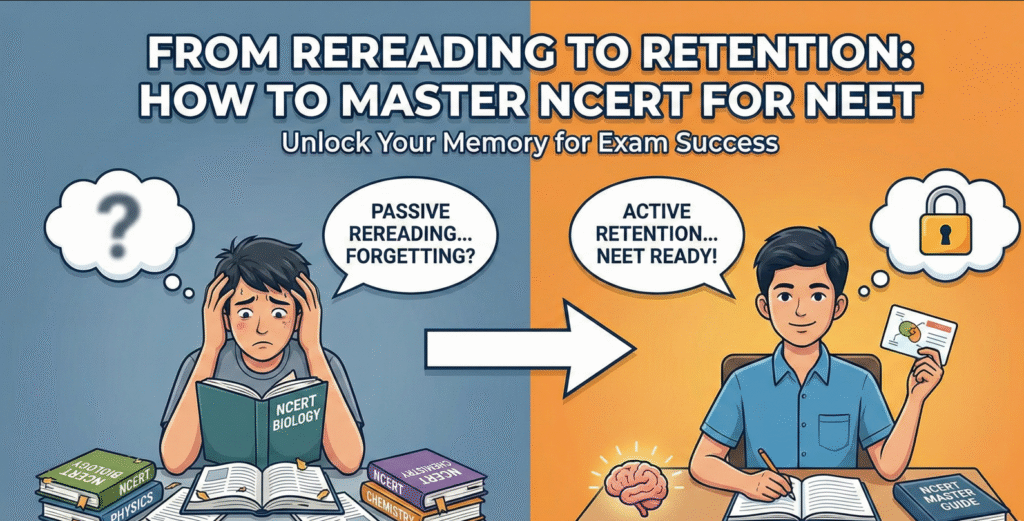
From Rereading to Retention: How to Lock NCERT in Memory for NEET
By Dr. Anurag Mittal Published on: January 24, 2026 Category: Biology Strategy / Memory trick
Related Reading: To build a complete NEET preparation roadmap, read our detailed strategy guide: The Ultimate 6-Month Strategy to Crack NEET 2026 .
A Note from the Author
Hello students, Welcome to my blog. I am Dr. Anurag Mittal, a Biology educator with over 15 years of experience teaching NEET aspirants at Aakash Institute, Ahmedabad. I now lead my own institute, The Biology Point by Dr. Anurag Mittal, where we focus on building strong conceptual understanding and effective study habits for NEET success.
Through years of teaching NEET aspirants, I have learned that success depends not on how many times NCERT is read, but on how well it is remembered. The methods shared in this article are based on practical classroom experience and proven learning principles. My goal is to help students study more effectively and approach NEET with confidence.
NCERT is the backbone of NEET Biology. Yet most students read it multiple times and still forget important lines during tests. This happens because reading alone builds familiarity, not long-term memory.
To score high in NEET, students must move from passive reading to active memory-building techniques. This article explains a scientific and practical system to convert NCERT knowledge into exam-ready retention.
Why Most Students Forget NCERT
Many aspirants highlight lines, underline paragraphs, and reread chapters repeatedly. However, during mock tests, recall fails under pressure.
This occurs because:
- Rereading does not strengthen memory pathways
- Long study sessions cause mental fatigue
- No structured revision cycle is followed
- Sleep and recall practice are ignored
Effective preparation requires active retrieval, not passive exposure.
Technique 1: Retrieval-Based Study (Active Recall)
Active recall forces the brain to retrieve information instead of simply recognizing it.
Method:
- Read one NCERT paragraph carefully
- Close the book
- Recall key points in your own words
- Write or speak them without looking
If you cannot recall, revisit the paragraph and repeat the process.
The mental effort during recall is the stage where long-term memory is formed.
Technique 2: Scheduled Revision (Spaced Repetition)
Studying an entire chapter in one day creates temporary memory. True retention develops when revision is spread over time.
Recommended revision cycle:
- Day 1 – Study the topic
- Day 2 – First revision
- Day 4 – Second revision
- Day 7 – Final short revision
Each revision strengthens neural connections and reduces forgetting.
Technique 3: Concept Visualization
The brain remembers images better than text. Convert NCERT concepts into diagrams and mental pictures.
Examples:
- Cell organelles as departments of a factory
- Blood circulation as a transport system
- Krebs cycle as a circular production line
Visualization makes complex biological processes easier to recall in exams.
Technique 4: Learning Through Explanation (Teach to Learn)
A concept is mastered only when it can be explained in simple language.
Practice method:
- Explain a topic as if teaching a junior student
- Avoid copying NCERT sentences
- Use your own words
If you struggle to explain, identify the gap and return to NCERT for clarification.
Technique 5: Sleep and Memory Consolidation
Studying alone does not permanently store memories. Sleep is required for consolidation.
During sleep, especially REM cycles, the brain organizes and stabilizes learned information.
Students who sacrifice sleep often experience:
- Poor recall
- Reduced concentration
- More mistakes in tests
Rule: 7–8 hours of sleep is part of your study strategy.
Technique 6: Subject Rotation (Interleaving)
Studying one subject continuously for long hours makes the brain passive.
Instead of:
- Biology for 6–8 hours
Try:
- Biology → Physics → Chemistry → Biology
This keeps the brain alert and improves problem-solving ability.
Daily Study Cycle for NCERT Mastery
Follow this effective cycle:
Read → Recall → Visualize → Revise → Explain → Sleep → Repeat
This transforms NCERT from temporary knowledge into permanent memory.
Final Principle: NCERT Must Be Retrieved, Not Just Read
NEET does not test how many times you have read NCERT. It tests how well you can recall and apply it under pressure.
Students who succeed in NEET do not study longer hours. They study smarter using memory-based techniques.
About The Biology Point by Dr. Anurag Mittal
At The Biology Point by Dr. Anurag Mittal, we focus not only on completing the syllabus but on building strong conceptual memory from NCERT. Our classroom teaching integrates active recall, structured revision cycles, visualization methods, and regular testing to ensure that students truly retain what they study.
Our mission is to help NEET aspirants develop scientific learning habits that convert NCERT knowledge into exam-ready performance with confidence and clarity.
Because NEET is not about reading more — it is about remembering better.
Want personalized NEET Biology guidance?
Contact us at The Biology Point by Dr. Anurag Mittal and start your focused NEET preparation today.
Frequently Asked Questions (FAQs)
How many times should I read NCERT for NEET Biology?
There is no fixed number. Instead of repeated reading, focus on active recall and structured revision cycles. Quality of recall matters more than the number of readings.
Is active recall better than rereading?
Yes. Active recall forces the brain to retrieve information, which strengthens long-term memory and improves exam performance.
How can I remember Biology diagrams from NCERT?
Convert diagrams into mental images, redraw them regularly, and explain them aloud in simple language to strengthen retention.
How many hours of sleep are required for better memory?
Students should aim for 7–8 hours of sleep daily. Sleep helps consolidate learned information into long-term memory.
Can these techniques be used for Physics and Chemistry also?
Yes. Active recall, spaced repetition, and subject rotation are effective for all NEET subjects, not only Biology.